Long-form writing from Chef Devin Dedier, on flour, on cheese, on hospitality, on what we do here and why we do it the way we do. New here? Start with what Roman cooking actually is.
Ninety-Six Hours. A field report from Mother's Day weekend at an Italian restaurant in El Dorado Hills.
By Chef Devin Dedier, Vacanza Romana, El Dorado Hills
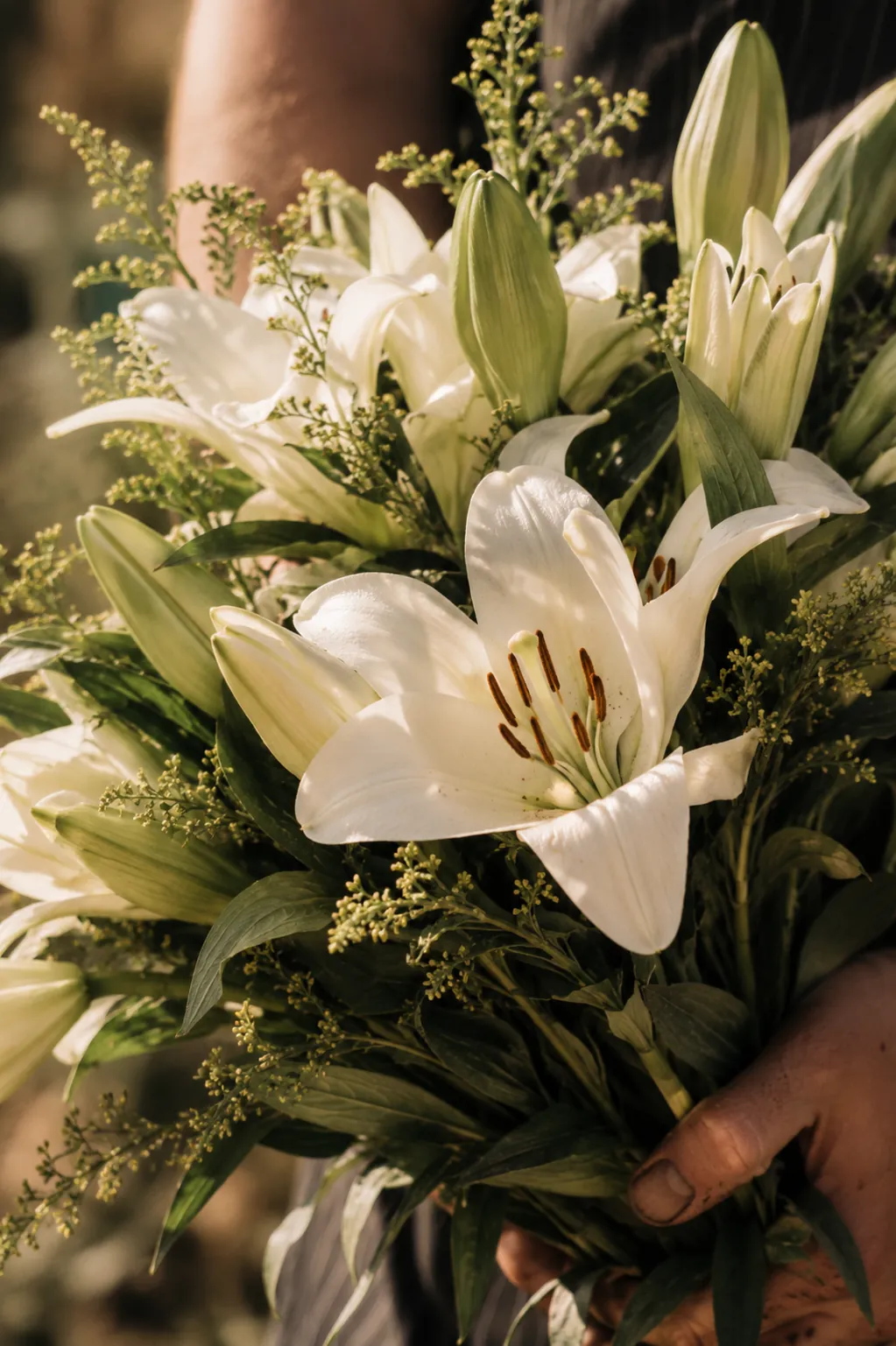
White lilies on a Sunday in May. The dining room was full of mothers.
Every May, somewhere around the second Sunday of the month, a peculiar thing happens to the American restaurant industry. The phone starts ringing. And then it keeps ringing. And then it does not stop ringing for about ninety six straight hours.
This past Sunday, May 10th, 2026, was another Mother's Day. By every measure I have ever seen, Mother's Day is the single busiest restaurant day of the year in the United States. Bigger than Valentine's Day. Bigger than New Year's Eve. Bigger than Father's Day, which, look, dads, we love you, I'm one myself, but we fail in comparison to the Super Bowl that is Mother's Day.
Here at Vacanza Romana, our authentic Italian restaurant in El Dorado Hills, we love it. We really do. We love it the way a triathlete loves the third lap of a sprint. Painful, demanding, and somehow the whole point. But every year I am reminded that not everybody quite understands what is happening on the other side of that swinging kitchen door. So in the spirit of honesty and a little late night humor, let me walk you through what the last four days actually looked like inside our Roman osteria off Vine Street.
Two Mother's Days, one Sunday
Here is something a lot of Americans do not realize. Mother's Day in Mexico, Día de las Madres, is always celebrated on May 10th. Not the second Sunday of May. Just the 10th. Period. Every single year.
Most years that means restaurants in El Dorado Hills, Folsom, Granite Bay and the rest of the Sacramento region get two beautiful waves on two different days. One on the actual 10th for our Mexican American guests and their families, and another on the second Sunday for everybody else. Two separate celebrations. Manageable. Lovely.
This year? Mother's Day in the United States and Día de las Madres in Mexico landed on the exact same Sunday. May 10th, 2026, fell on the second Sunday of the month. Two cultures, two beautiful traditions, one set of dining tables, all converging on one extremely lively Italian restaurant in El Dorado Hills.
It was, in technical industry terminology, a lot.
"Wait, you guys are booked for Sunday? But it's two weeks away."
That was an actual phone call.
Sunday was the easy part
You would think the actual day, the big show, the second Sunday of May, would be the hardest. It was not. Sunday was the day every restaurant in Folsom, El Dorado Hills, Granite Bay and the greater Sacramento area was fully staffed, fully prepped, and fully braced. By Sunday morning, our back of house had been running drills for four straight days. The line cooks were already deep in the zone. The pasta was rolled. The sauces were reduced. The dough was ready. We were ready.
What was hard was the part nobody warns you about. It was the four days leading up to it.
Friday: the smart ones
Friday belonged to the families who knew, weeks in advance, that they were never going to get a Mother's Day table on Sunday. So they did the smart thing. They booked Friday.
Friday Mother's Day diners are the snipers of the operation. Calm. Strategic. Two glasses of Cabernet in. They walk in two days early, get the better table, get the slightly less hammered version of every server in the building, get the same wine, the same Sunday gravy, the same handmade pasta, the same fresh ricotta agnolotti, the same Roman osteria experience that the Sunday crowd is fighting for tooth and nail. They beat the rush and they know it. We love these people. If you have ever wondered who has cracked the code for a great date night Italian restaurant in El Dorado Hills, it is them. They have.
Saturday: an absolute beast (and a beautiful one)
Saturday is, by volume, almost as crazy as Sunday. It is a Mother's Day overflow day, a date night day, a graduation day, and, in the case of this past weekend, a prom day.
On Saturday, May 9th, Oak Ridge High School held its prom. I forgot. I will admit it. I had Mother's Day on a whiteboard in fifteen places in our kitchen. Prom was not on the whiteboard. I should have known. Oak Ridge is right down the road. Half the cars in our parking lot every spring have an Oak Ridge sticker on the back windshield.
So at 5:45 PM on Saturday, just as our Mother's Day overflow seating was hitting peak, twelve immaculately dressed teenagers walked into our dining room for the early part of their prom dinner. Tuxedos. Floor length gowns. Corsages. Phones out. They were lovely. Their parents were proud. Our team rose to it. We squeezed them in. We made it beautiful. The kids took photos by the wine wall. One mom may have cried. (Hi, Mom.)
And our kitchen, on its third long Saturday in a row, found the next gear. We always do. That is not a brag. That is the job.
What "we open earlier and stay open later" actually means
For Mother's Day weekend, we open our dining room earlier than usual. Doors at 11 AM on Sunday instead of noon. The bar opens an hour ahead of that, because some of you want a Negroni before brunch, and we respect that deeply. We hold seating later into the night every day from Friday through Sunday.
That sounds like four extra hours. It is not four extra hours. It is roughly forty extra hours of work, by the time you account for prep, deep clean, restock, the second wave of mise en place, and the very real labor of putting a 220 cover dining room back together at 11:30 PM on Saturday so that we can do it all again at 11:00 AM on Sunday.
Our line cooks were in the kitchen at 7 AM on Sunday. They had been there until midnight the night before. Mother's Day, in restaurant terms, is an athletic event. Three days, three nights, no off ramp.
Now, the spin. And I am not kidding.
All of this is to say: Mother's Day weekend at any real Italian restaurant in Folsom, El Dorado Hills, Granite Bay, Cameron Park, Rescue, Shingle Springs, Placerville, Roseville, or anywhere in the greater Sacramento region, is the most glorious chaos of our entire year. And we love it. We genuinely, completely, head over heels, love it.
We love it because the dining room is full of mothers. The actual reason any of us are here at all. We love it because three generations of one family are sitting at a six top and the grandma is laughing at something her daughter said, and the toddler is wearing half a meatball, and dad is taking a picture of the pasta instead of the people. We love it because every single dish that goes out of the kitchen pass on Mother's Day goes out with a little extra care. The plating is just slightly tighter. The pasta is rolled just slightly thinner. The cocktail is just slightly more beautiful. That is not an accident. That is the team showing up.
We love it because by Sunday night, when the last table has lingered over dessert, and the family meal is finally happening at the bar at 10:30 PM, we look around at each other and we know we did something.
The dining room was full of mothers. The actual reason any of us are here at all.
A small ask, with a wink
If your favorite Italian restaurant in El Dorado Hills (and we promise that is us) ever seems a little extra crispy on the Friday before Mother's Day, give us grace. If the Saturday before Mother's Day is the most popular Saturday of the year and we run a few minutes behind on a table turn, we appreciate your patience. We are not slow. We are full. And in our world, full is good.
If the second Sunday in May ever feels like the entire Sacramento region has decided to eat lunch in the same five dining rooms at the same time, that is because we did. And it is beautiful. And we are so glad you came.
And if you are ever planning a quiet date night, an anniversary, a birthday, a graduation dinner, a Father's Day in June, a Sunday Bolognese with the in laws, or a regular Tuesday that you just do not feel like cooking on, please remember the lesson of Mother's Day weekend.
The calmest, quietest, most spoiled for attention version of our Roman osteria does not happen on the holiday. It happens on the Tuesday.
Come see us on a Tuesday. We will save you a seat.
To every mother who let us cook for her this weekend. To every daughter and son who booked the table. To every Mexican American family who celebrated their mama twice, once on the calendar and once on the Sunday. To the prom kids who picked our dining room as the start of their night. To the staff who showed up every single shift and worked harder than anyone outside of this industry will ever fully see. Grazie. We are so lucky to do this for you.
See you next year. And every Tuesday in between.
Chef Devin Dedier
· · ·
I · On Flour · 2026
You're not allergic to gluten. You're allergic to what we did to it.
By Chef Devin Dedier · Vacanza Romana, El Dorado Hills
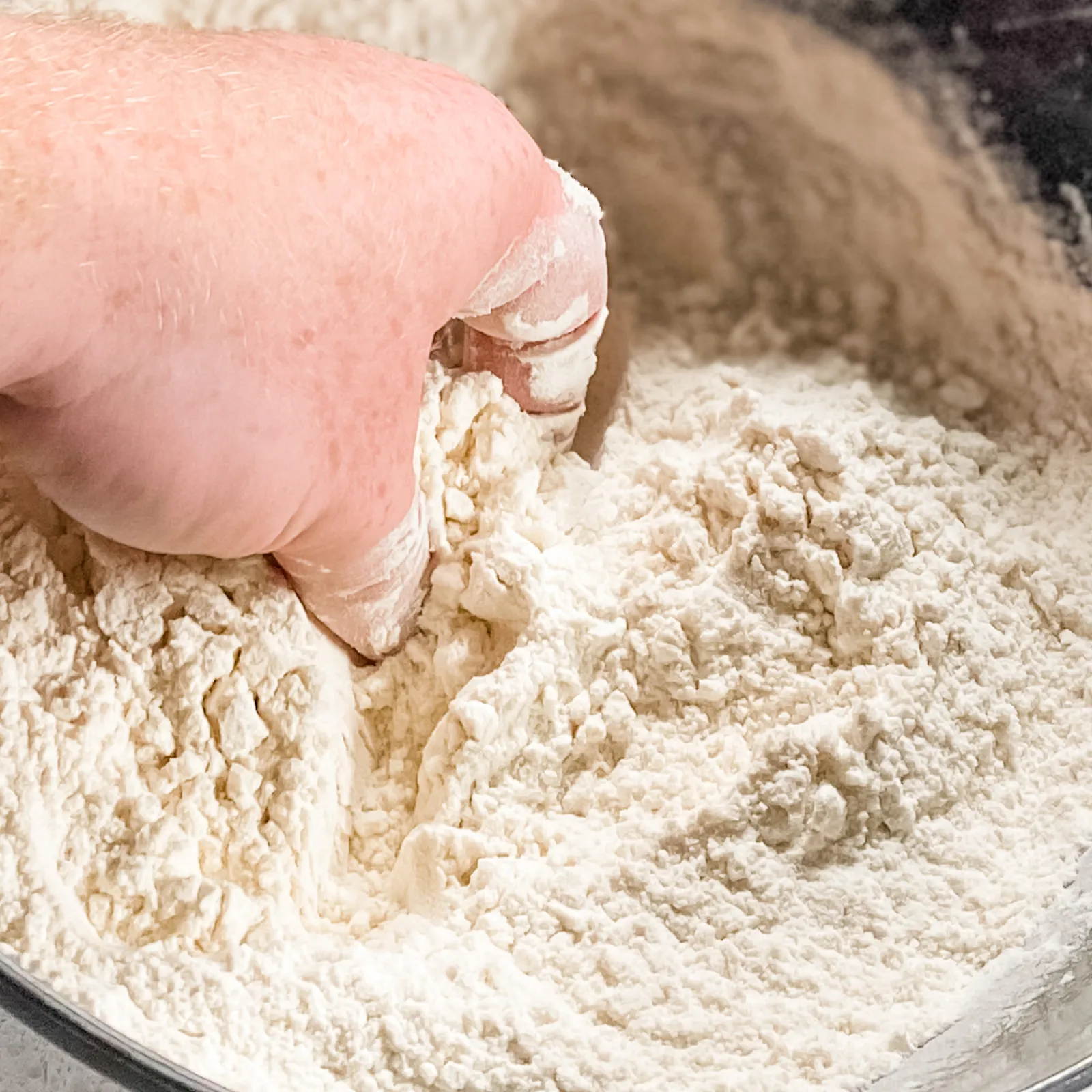
Tipo 00, imported from Italy. Just wheat, the way it has been for nine thousand years.
Let me say this up front, because it matters.
I'm a chef, not a doctor. If you have celiac disease (a serious autoimmune condition where your body literally attacks itself when it sees gluten), none of what I'm about to say applies to you. Stay away from wheat. Eat the gluten-free pasta. Take care of yourself. We'll cook for you, gladly, and we'll make sure you leave happy.
But I want to talk to the rest of you. The ones who say things like:
"I get bloated every time I eat bread in America. But when I went to Italy, I ate pasta every day for two weeks and I was completely fine."
I hear that sentence at least once a week at Vacanza Romana. Sometimes more.
I hear it because it's true. And once you understand what's actually in most American flour, and what isn't in Italian flour, it stops being a mystery.
What's actually in American flour
Here's a list of things the United States allows in commercial flour that most of Europe banned thirty-plus years ago:
Potassium bromate. Banned in the European Union in 1990. Banned in Canada in 1994. Banned in over 40 countries. Still legal in the United States. The FDA has recommended American bakers stop using it, because it's been shown to cause kidney, thyroid, and gastrointestinal cancers in animal studies. Recommended. Not banned.
Bleaching agents. Chlorine, peroxide, chlorine dioxide, azodicarbonamide. Banned across the EU since the 1990s. Still legal in U.S. flour. They make flour whiter and faster to age artificially, which is good for industrial bakeries and bad for everything else.
Glyphosate. The active ingredient in Roundup. In the U.S., it's commonly sprayed on wheat fields a week or two before harvest as a "desiccant": the chemical kills the wheat plant so it dries down faster and the farmer can harvest sooner. The chemical residue is then in the wheat. The practice is restricted across most of Europe.
Now look at the other side. European flour regulations are, as one industry source puts it bluntly: "100% grain and nothing else". No chemical bleaching, no chemical aging, no synthetic additives, no treatments of any kind.
That's not me being a romantic. That's literally the law there.
The other half of the story: ATIs
Now here's the part of the science that's getting more interesting every year.
Researchers have started studying a class of proteins in wheat called ATIs, amylase/trypsin inhibitors. These are natural pesticides the wheat plant produces to defend itself against bugs and fungus. The problem: in the human gut, ATIs activate something called the TLR4 immune complex, which is the same pathway that drives inflammation. When researchers fed ATIs to lab animals, intestinal and respiratory inflammation went up.
ATIs are now considered one of the leading suspects behind non-celiac gluten sensitivity, the condition that affects an estimated 6% of Americans, who get bloated, foggy, fatigued, and miserable when they eat wheat, even though they don't have celiac disease and don't test as wheat-allergic.
Different wheat varieties have different ATI profiles. Different milling traditions handle the wheat differently. Different agricultural systems grow the wheat differently. And then there are the additives: the bromate, the bleach, the glyphosate residue, which exist in the U.S. supply chain and don't exist in Italy's.
It is not a mystery, in other words, why so many people feel completely different eating wheat in Rome than they do eating wheat in Sacramento.
Why we import our flour from Italy
We import our flour from Italy.
Specifically, we use Tipo 00 flour, the finely-milled, soft-textured flour that has been the standard for Italian pasta and pizza for generations. It's grown without pre-harvest glyphosate. It's milled without bleaching agents. It's not aged with chemical additives. It is, by EU law, just wheat. The way wheat has been wheat for nine thousand years.
We pay more for it. A lot more. Cheaper American flour is sitting on a shelf at Restaurant Depot every morning, waiting to be picked up. We don't pick it up. The number one reason isn't taste, though the taste is better. The number one reason is what doesn't go into it.
We roll our pasta in-house, every day. We rest the dough, the way you're supposed to. We don't rush it. We don't bleach it. We don't add anything to it.
"Am I going to be sick?"
Almost every week, somebody walks into our dining room, the kind of guest who has spent the last ten years avoiding wheat, and apologetically asks the question:
"Am I going to be sick if I eat this?"
Here's what I tell them: I'm not a doctor. If you have celiac, please don't risk it. But if you're someone who has been told you have a "gluten sensitivity" and you've been miserable for years, try a small portion of our pasta and see how you feel.
I have lost count of the number of people who have come back the next week, sat at the bar, and told me they had no reaction. None. They ate it, slept fine, woke up fine, and were back in for more.
The science is starting to back up what those guests are reporting.
If you're one of the 6% of Americans who's been told you have a gluten sensitivity, there is at least a chance, and a growing one, as the research deepens, that gluten was never the problem.
The problem was what we did to it.
The pre-harvest glyphosate spray. The chemical bleach. The potassium bromate. The shortcuts. The factory-flour chain that exists to drive prices down and shelf life up. The ultra-processing of one of the most ancient, most nourishing foods on Earth.
The problem isn't a single grain that has fed the Mediterranean for nine millennia.
You're not allergic to gluten. You're allergic to what we did to it.
The Roman test
There's a little experiment I tell every skeptical guest to run. The next time you fly to Italy (Rome, Florence, Naples, anywhere), eat pasta every day. Eat bread every day. Eat the real stuff. Track how you feel.
Almost nobody comes back and tells me they got bloated.
You don't have to fly to Rome to do that experiment. You can come sit at our dining room in El Dorado Hills. Same flour. Same standards. Same care. Same nine-thousand-year-old grain, grown and milled the way it's supposed to be.
We'll cook you a plate, and we'll let your gut decide.
Chef Devin Dedier
Important: This article is not medical advice. If you have celiac disease, a wheat allergy, or any chronic gastrointestinal condition, please consult a qualified medical professional before changing your diet.
· · ·
II · On the Card · 2026
If the label says "parmesan," it probably isn't parmesan.
A quick lesson in DOP, by Chef Devin Dedier
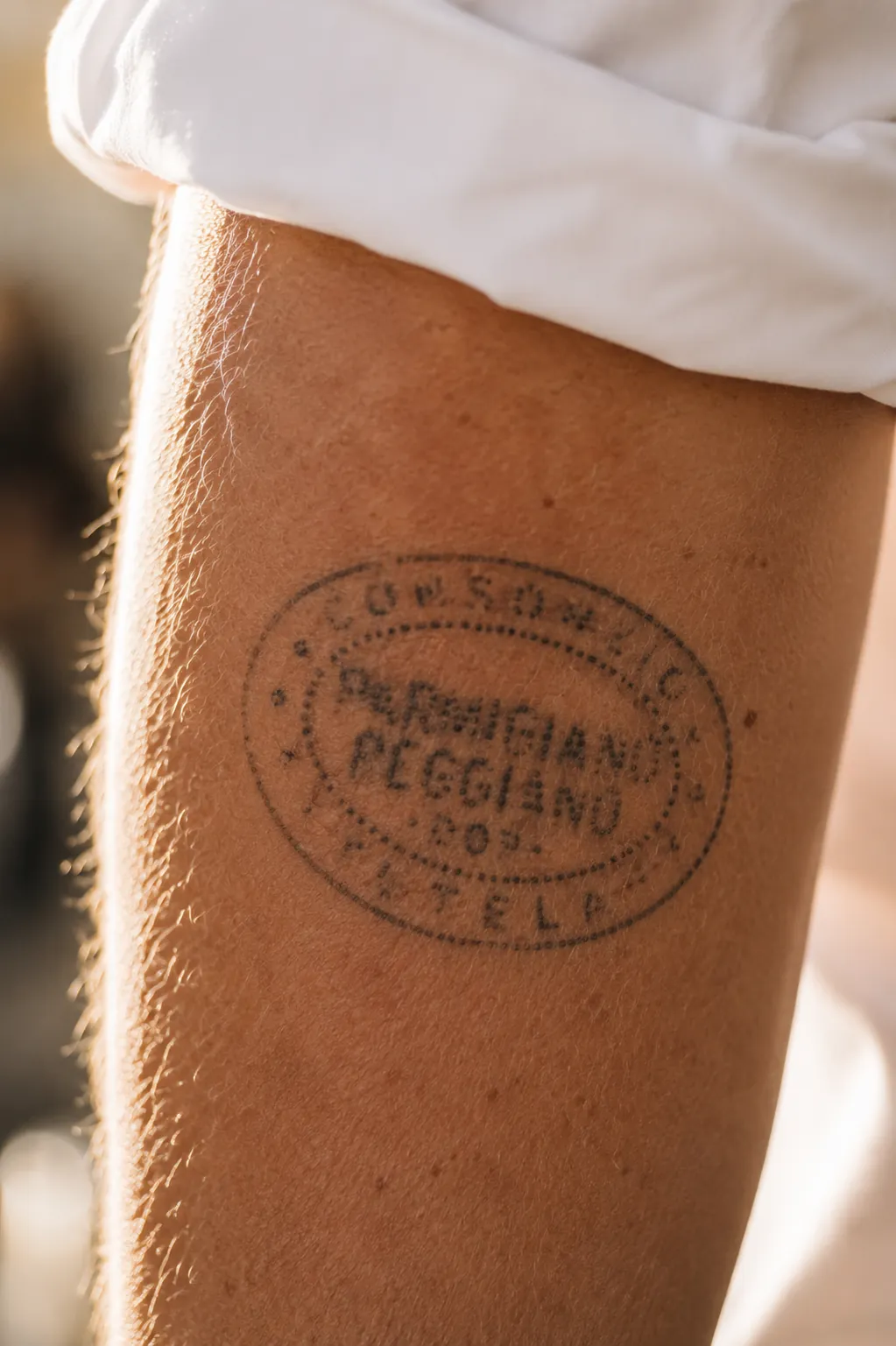
The Consortium oval, fire-branded onto every wheel that passes the hammer test. And, yes, onto one chef's forearm.
Walk into any American grocery store and pick up the green can.
The label says "parmesan."
It is not parmesan.
It's also not Parmigiano. It's not Parmigiano Reggiano. It's not even, technically, cheese in the way the rest of the world defines cheese. It is, depending on the brand, a powdered dairy product mixed with cellulose (yes, wood pulp), preservatives, and anti-caking agents.
I'm not telling you this to make you feel bad about anything in your pantry. I'm telling you because at Vacanza Romana, we use only real, DOP-protected Parmigiano Reggiano, and I think every diner who eats Italian food deserves to understand the difference. Once you do, you can't unlearn it.
What "DOP" actually means
DOP stands for Denominazione di Origine Protetta: Protected Designation of Origin. It's the Italian version of an EU-wide system (PDO in English) that legally protects specific foods that can only be made in a specific place, in a specific way, by specific people, with specific ingredients.
Real Parmigiano Reggiano has been DOP-protected since 1996. The rules around how it's made are some of the strictest of any food on Earth.
Here's what the DOP requires.
Geography. Every wheel of Parmigiano Reggiano must be made within a tiny corner of Italy: the provinces of Parma, Reggio Emilia, Modena, and parts of Mantua and Bologna, in the Emilia-Romagna region. If it is made anywhere else on planet Earth, it is not Parmigiano Reggiano. Wisconsin "parmesan" is not Parmigiano Reggiano. Argentinian "parmesan" is not Parmigiano Reggiano. There is no such thing as "California Parmigiano Reggiano." It is a name that is, by international law, tied to a specific place.
Cows. The cows must be raised inside that zone and fed exclusively on locally-grown forage. Silage is forbidden. Fermented feed is forbidden. The animals' diet is regulated by law.
Three ingredients. That's it. Real Parmigiano Reggiano contains, by law: raw cow's milk, natural whey starter, and calf rennet. Nothing else. No additives. No colorings. No preservatives. No anti-caking agents. No cellulose. No "natural flavors." No emulsifiers. No vegetable oils.
Copper cauldrons. The cheese is still, by law, made in copper cauldrons. The same way it has been made for nine centuries.
Aging. Each wheel must age, inside the production zone, for a minimum of 12 months. Most commercially available wheels are aged 24 months. Many are aged 36. Some, the truly extraordinary ones, are aged 48 months and beyond.
The hammer test. Every single wheel produced is inspected, by hand, by a Consortium-trained inspector who taps the wheel with a small hammer and listens to the sound. A clear, even ring indicates a properly formed interior. An irregular or dull sound may indicate cracking or other defects. Wheels that fail get rejected. Only wheels that pass get fire-branded with the official Parmigiano Reggiano oval mark and the date stamp.
This is not a marketing claim. This is law.
What "parmesan" means in America
Now compare that to what "parmesan" means in the United States.
In America, the word "parmesan" is generic. It refers to a style of grated hard cheese. Anyone can stamp the word on the label of anything that loosely resembles aged cow's milk cheese. There's no aging requirement. There's no geographic requirement. There's no rule about what's in it.
The Consortium that protects Parmigiano Reggiano has actually published a public statement about this: "Parmesan" has nothing to do with the traceability of the king of cheeses, Parmigiano Reggiano.
When you see "parmesan" on a menu in America, it can mean any of three very different things:
Real, imported, DOP-stamped Parmigiano Reggiano. The king.
A domestically-produced "parmesan-style" hard cheese with no protected origin and no aging requirement.
Powdered industrial cheese product: the green can, the bagged grated stuff in the deli case, full of stabilizers and cellulose.
You almost never know which one you're getting. Unless the menu explicitly says Parmigiano Reggiano in full, ideally with the aging in months listed (24 mesi, 36 mesi), you're guessing.
Why it matters in the pan
This isn't food snobbery. The difference matters in the cooking. It matters on the plate. It matters in your mouth.
Real Parmigiano Reggiano is, by weight, one of the most concentrated natural sources of glutamates (the savory, umami flavor compound) of any food in the world. Aged 24 months, it has a depth and a complexity that you cannot fake. It crumbles a specific way. It melts a specific way. It carries a sauce a specific way.
When you grate real Parmigiano Reggiano over a hot bowl of cacio e pepe, the cheese melts into the pasta water, emulsifies with the starches the pasta has released, and turns into the silky, glossy, almost-impossibly-creamy sauce the dish is famous for. The whole magic of cacio e pepe, the reason Roman grandmothers have been making it for centuries with three ingredients, is that emulsification.
Try the same dish with green-can powder. You won't get a sauce. You'll get a clumpy, oily, sad mess that breaks the moment you stir it. The emulsion never forms. The pasta sits there in a puddle. The dish dies.
That isn't a difference of opinion. That's chemistry.
The same is true for carbonara. The same is true for lasagna, where the Reggiano in the besciamella is doing structural and flavor work at the same time. The same is true for a simple Sunday Bolognese, finished tableside with a curl of Reggiano shaved off a wedge that's been aged for two years longer than your kid's been alive.
Real Parmigiano Reggiano isn't a topping. It's an ingredient. It's a structural element. It's the reason Italian cooking can do so much with so little.
What we do at Vacanza Romana
Every wheel of Parmigiano Reggiano on our line is the real thing: DOP-stamped, made in Emilia-Romagna, aged a minimum of 24 months. We can show you the rind. The fire-branded oval is still on it.
When we shave it over a plate of carbonara, when we melt it into cacio e pepe, when we grate it over a Sunday Bolognese, when we fold it into a fresh ricotta filling for our agnolotti, the cheese is doing what it's been doing in Italian kitchens for nine centuries.
You are not eating "parmesan." You are eating one of the most carefully made foods on Earth.
You can taste the difference. We promise you can.
If you live in El Dorado Hills, Folsom, Cameron Park, Granite Bay, or anywhere in the greater Sacramento area, and you have never tasted what real Parmigiano Reggiano can do in a sauce, that's a fixable problem.