From Chef Devin Dedier · El Dorado Hills
Cacio e pepe translates, flatly, to "cheese and pepper." That is the entire recipe. Pecorino, black pepper, pasta, and the water the pasta cooked in. No cream. No butter required to make it work. No garlic, no onion, no stock. It is the most honest plate in the Roman repertoire, and that honesty is exactly what makes it so hard.
With three ingredients, there is nowhere to hide.
Every other sauce gives a cook somewhere to bury a mistake: a little more fat, a little more acid, a longer simmer. Cacio e pepe gives you nothing. If the sauce breaks, everyone can see it. If the pepper is stale, it tastes of nothing. There is no rescuing it after the fact. You get it right in the pan or you don't get it at all.
Three ingredients
- Cacio: pecorino romano, the sharp, salty sheep's-milk cheese. It is the flavor and, melted properly, the body of the whole sauce.
- Pepe: black pepper, toasted to wake up its oils and ground coarse. In cacio e pepe the pepper is not seasoning; it is a main ingredient, with real heat and perfume.
- Pasta water: the unsung third ingredient. The cloudy, starchy water the pasta releases as it cooks is what lets the cheese melt into a sauce instead of a clump.
Why it's hard: the emulsion
Here is the whole trick, and the whole difficulty. Grated pecorino, left to its own devices in a hot pan, does the worst thing imaginable: it seizes. The proteins tighten, the fat weeps out, and you are left with a greasy puddle and a rubber ball of cheese. Everyone who has tried this at home has made that mistake once.
The fix is an emulsion. The starch suspended in the pasta water acts as the bridge, holding the melted cheese and its fat together in a single smooth, glossy sauce that clings to every strand. Get it right and it is creamier than anything you could do with cream, and there is no cream in it. Get the temperature wrong and it falls apart in seconds. Too hot and the cheese seizes; too cool and it never melts. It lives in a narrow window, and finding that window, over and over, under the pressure of a full dining room, is the craft.
Creamier than cream.
Without a drop of it.
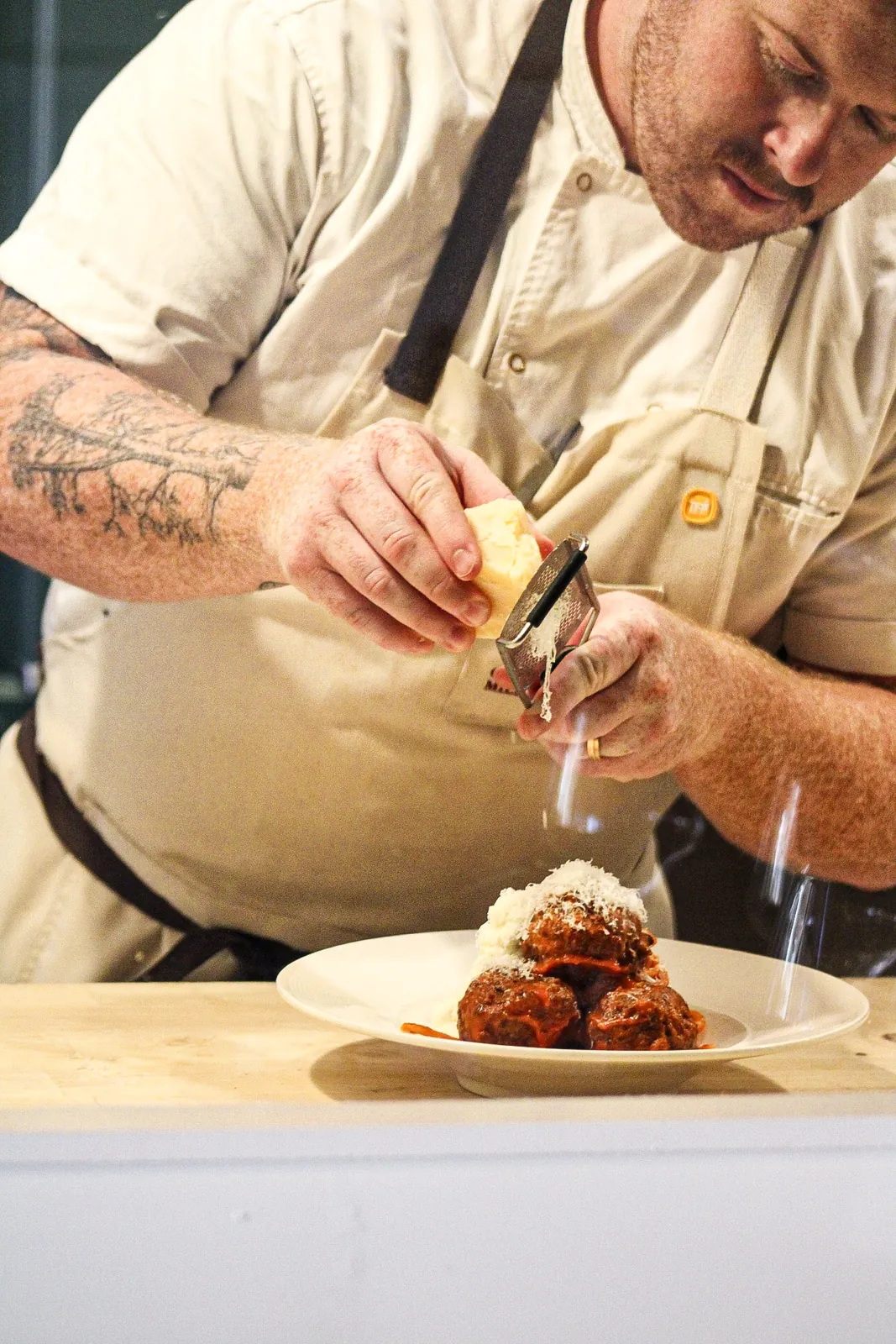
How we make it at Vacanza Romana
Our cacio e pepe starts with tonnarelli, a square-cut fresh pasta, a little thicker than spaghetti, with a rough surface that grabs the sauce. The pepper is toasted tellicherry, bloomed for aroma and bite. The cheese is due pecorini, two pecorino cheeses layered for depth rather than one note. And we finish it with a touch of white truffle butter, a Californian wink that rounds the edges without ever turning it into a cream sauce. The core of the dish is still, and always, the emulsion: cheese, pepper, and starchy pasta water, brought together by hand.
The tonnarelli is rolled in-house, like all our pasta. More on that in pasta, made by hand every morning. And if you want to see where this dish sits among its siblings, start with what Roman cooking actually is.
Questions
Does cacio e pepe have cream?
No. It's pecorino, black pepper, and starchy pasta water. The creaminess comes from emulsifying the cheese with the starch in the water, never from dairy cream.
What are the three ingredients?
Pecorino romano (cacio), black pepper (pepe), and pasta, with the starchy cooking water doing the work of bringing the sauce together.
Why is it so hard to make?
With so few ingredients there's nowhere to hide. The cheese has to emulsify into a smooth, glossy sauce. Too hot and it seizes into clumps; too cool and it won't melt. It takes temperature control and timing, which is why a three-ingredient dish is one of the hardest in Rome.
How do you make yours?
Tonnarelli, toasted tellicherry pepper, two pecorino cheeses, and a touch of white truffle butter. The emulsion is cheese, pepper, and pasta water. No cream. Find it on the menu.