From Chef Devin Dedier · El Dorado Hills
People hear "Italian food" and picture a long table groaning under the weight of everything at once: a dozen cheeses, a pound of cream, garlic in every pan, a sauce that has been simmering since the day before yesterday. That is a real and wonderful kind of eating. It just isn't Roman.
Roman cooking, cucina romana, is the opposite of abundance for its own sake. It is a poor city's food, dressed up over centuries by cooks who never had very much and learned to make a great deal out of it. A Roman plate is usually three or four ingredients, each of them very good, handled with precision and respect and not much else. The discipline is the flavor.
Rome wrote the recipes. California fills the pantry.
At Vacanza Romana, our chef-driven, family-owned Roman Italian restaurant in El Dorado Hills, minutes from Folsom, the bones of the menu are Roman and the fingerprints are Californian. This page is the long version of why. Think of it as the map. From here you can wander off into the four pastas, into the one dish that explains the whole cuisine, and into how we make pasta by hand every morning.
A cuisine built on a few great ingredients
If you want to understand Roman food, learn its pantry. It is short, and almost every classic dish is some combination of the same handful of things:
- Guanciale: cured pork jowl. Not bacon, not pancetta. It renders into something silkier and more savory than either, and it is the backbone of three of the four classic pastas.
- Pecorino romano: a hard, salty sheep's-milk cheese. Sharp where parmigiano is nutty. It is the cheese Rome built its sauces on.
- Black pepper: not a garnish in Rome but an actual ingredient, toasted and ground coarse until it carries real heat and perfume.
- Egg: specifically the yolk, tempered gently into hot pasta to make a sauce without a drop of cream.
- Tomato: used sparingly and well. San Marzano, bright and clean, not cooked to death.
- The artichoke: Rome's vegetable, fried whole until the leaves shatter like glass, or braised Roman-Jewish style.
Notice what isn't on that list. No cream. No heavy garlic. No long parade of competing flavors. Roman cooking trusts a small number of excellent things to do the work.
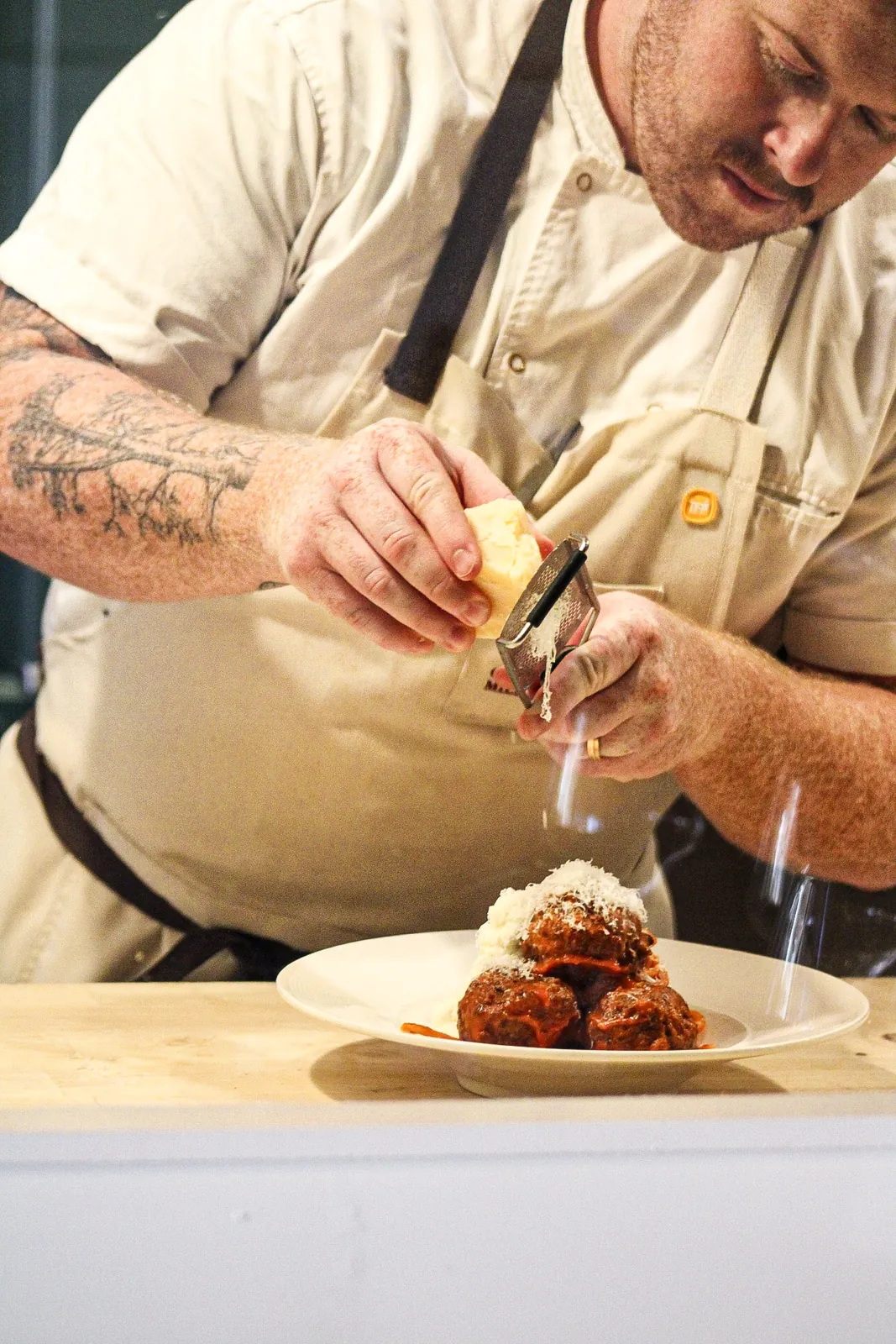
The four pastas the city built
There are four classic Roman pastas, and they are really variations on a theme, a family tree grown from the same few ingredients:
- Gricia: guanciale and pecorino romano. No egg, no tomato. This is the ancestor; everything else is gricia with one thing added.
- Amatriciana: gricia plus tomato.
- Carbonara: gricia plus egg.
- Cacio e pepe: the outlier, and the purest of all. Just pecorino, pepper, and starchy pasta water, emulsified into a sauce by technique alone.
We make these the way they're made there, not the way they got rewritten on the boat over. That means guanciale, not bacon. Pecorino, not a shaker of something labeled "parmesan." And in carbonara, egg yolk and nothing else binding it. Never cream.
Gricia, the ancestor, is part of the canon but isn't always on our card; its availability rotates with the season. Carbonara, cacio e pepe, and amatriciana are on the autumn menu now.
Guanciale, egg yolk, two cheeses, black pepper, and no cream, ever.
ReadThree ingredients, no shortcuts, and the hardest easy dish in Rome.
ReadRolled and extruded by hand every morning, from flour we bring in from Italy.
ReadThe Jewish-Roman table
You cannot explain Roman food without the Jewish Ghetto of Rome, one of the oldest Jewish communities in the world. Some of the dishes most associated with the city came out of that kitchen, and the most famous is carciofi alla Giudia, Jewish-style artichokes, trimmed down, pressed open into a flower, and fried whole until the outer leaves go crisp and bronze and the heart stays tender. It is one of the great fried things on Earth, and it is pure Roman precision: one vegetable, hot oil, salt, and timing.
We put that history on the plate. Alongside the artichokes you'll find Roman standards like supplì al telefono (fried rice croquettes that pull a string of cheese when you break them open), saltimbocca alla Romana, and ossobuco: the dishes a Roman cook would actually recognize.
How it differs from American-Italian
American-Italian is its own beautiful thing, born in the kitchens of immigrants who finally had access to meat and cheese and cooked with the joy of people who had gone without. But it drifted. Carbonara got cream. Alfredo became a cream sauce heavy enough to stand a spoon in. "Parmesan" became a word on a green can rather than a protected cheese. Everything got bigger, richer, and further from the spare, precise cooking it came from.
Roman cooking went the other way. It stayed lean. It kept trusting a few great ingredients and a cook's hands. When we say we cook the Roman way, that's what we mean: not more, but better.
Not more.
Better.
Where to taste it
Everything above is on the plate a few minutes off Highway 50, in El Dorado Hills Town Center, about five minutes from Palladio in Folsom, and a half-hour from Sacramento. Read on into the dishes themselves, or just come sit down and let us cook.
Reserve a table See the full menu
Chef Devin Dedier, Vacanza Romana · El Dorado Hills